 ECRANPAPIER
EDITER project presentation news
 ECRANPAPIER

The Production workshop concludes the EPE project's workshop-based cooperation program, after 5 workshops resulting in the production of around 25 experimental editorial projects, bringing together groups of students from different educational backgrounds and countries, crossing screen and paper using web-to-print technologies. The two years of the project were divided into two main phases, Propagation and Prototyping, with the final phase involving an attempt at full-scale Production, in a quasi-professional context. The Hexagone theater, a national scene located in the town of Meylan in the Grenoble metropolis, is our major partner for this last in situ action. In order to fulfill its mission of artistic production and distribution, mainly in the performing arts, the Hexagone has a small-scale communications team: 2 people invest their time in organizing and distributing information that will enable the public to discover the theater's program. Websites, posters and flyers are all tools already in place in the theater's communications, but one specific activity suffers from a certain invisibility: artist residencies, which appear only very occasionally in the institution's overall communications, and sometimes under several forms and names. Our proposition is that a team of people belonging to the EPE consortium participate in a workshop to produce plausible editorial chains dedicated to the valorization of activities generated by Hexagone's artist residencies: intermediate realizations, documents produced by the artists (texts, images, videos, audio recordings), public performances, master classes, etc.
“Doing what you can with what you've got” will go hand in hand with “tailor-made production”: as Hexagone cannot easily expand its communications team, the challenge is to analyze the needs when they are known, or, if not, to formulate them and propose editorial channels adapted to these needs and to the scale of the team in place. The variety of media potentially produced by guest artists calls for flexibility in the system for managing the sources that will be used to produce media that will add value to these residencies. This flexibility needs to be reflected in the editing tool that will enable those responsible for distributing this content to lay it out both on screen and on paper. We can therefore imagine a CMS-type tool built around the needs and proposals for distribution formats that will be designed in collaboration with the Hexagone team: desktop and mobile website with the possibility of printing simple objects (posters, flyers, stapled A5 booklets, etc.) on site or directly at the spectators' homes. The content management tool would allow a minimum of graphic adjustments: positioning of elements, styles. Depending on the format concerned (booklet, for example), an automatic page layout can be introduced, with certain content marked as having to fill predetermined page zones. Several editing chain hypotheses will be put forward, and one of them will be explored in greater depth to verify its suitability for real-life use. However, this will not be a finalized product available for use, but rather a prototype close to the “proof of concept” stage, which could eventually give rise to further developments to finalize the solution chosen by the Hexagone team.
The workshop took place at Atelier arts science from June 02 to 06 2025:
Y.SPOT PARTNERS / ATRIUM 5 place Nelson Mandela 38000 Grenoble https://www.atelier-arts-sciences.eu/
The partners taking part in this workshop are: L’Hexagone, l’Esad•Valence, l’ISAM de Sfax, Izmir Economics - VCD, Sarah Garcin.
Professors
Students
Professors
Students
Participants got to Grenoble from their respective working place.
Morning
Reviewing the information provided by Hexagone: the starting point wass at the crossroads of the Cahiers and the Rapports d'étonnement to formulate proposals for generic formats:
Presentation of an initial chain in Single Source Publishing, enabling a set of files to be used by several participants.
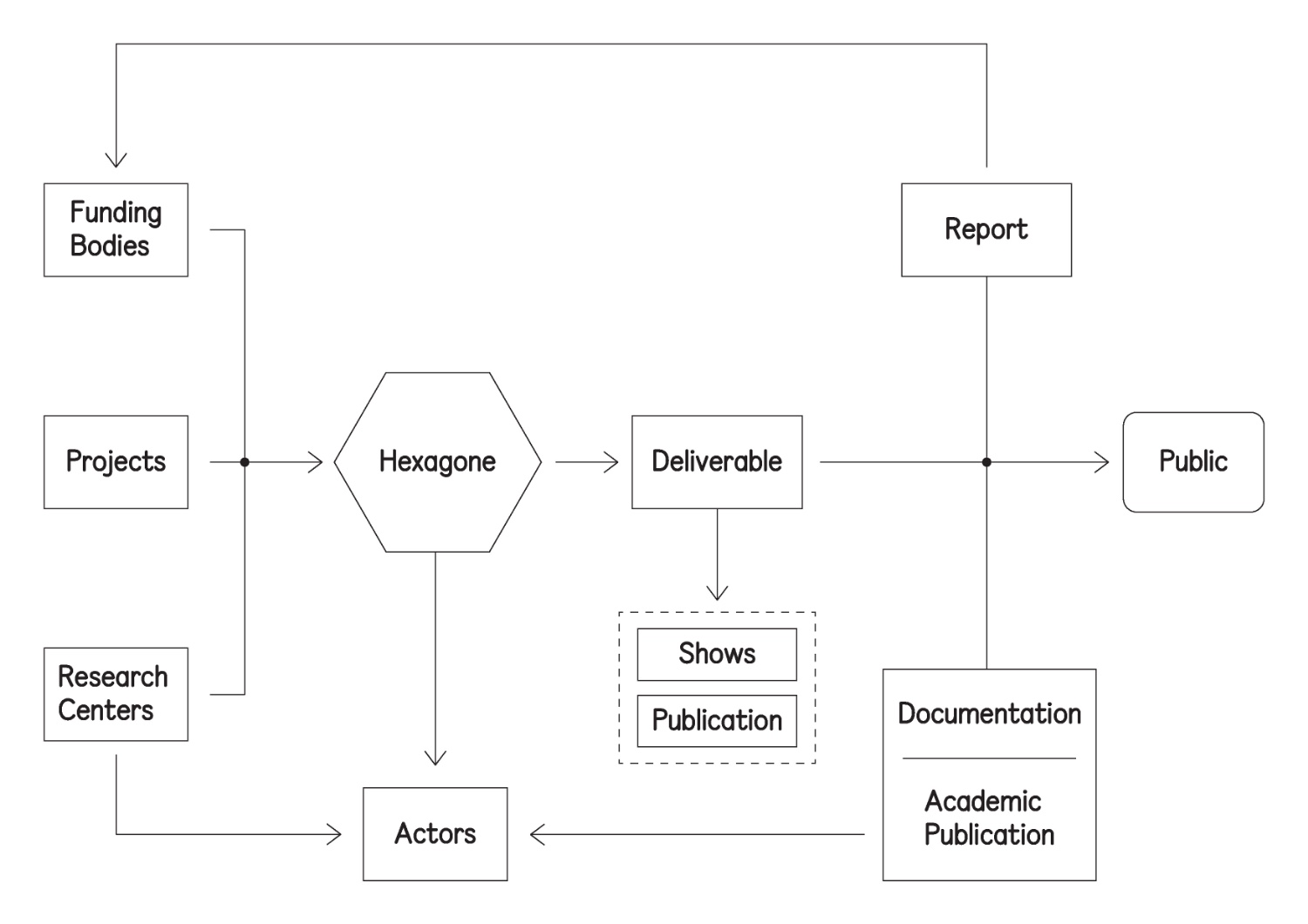
The Rapports d'étonnement were produced as part of the Scientific Exploration Artistic Group, a special residency programme involving scientists working at the CEA and artists invited by Hexagone. This residency programme had no production requirements and mostly consisted of dialogue sessions in various formats (round tables, seminars, workshops). The reports were produced by the group's participants, without any recommendations or templates provided in advance. These reports took the form of PDF files, with or without images, sometimes accompanied by internet links to various resources (audio, video). Understanding the structure of these residencies was fundamental for us, especially since the Rapports d'étonnement were the raw material we had prior to the workshop, as agreed with Hexagone's communications team.
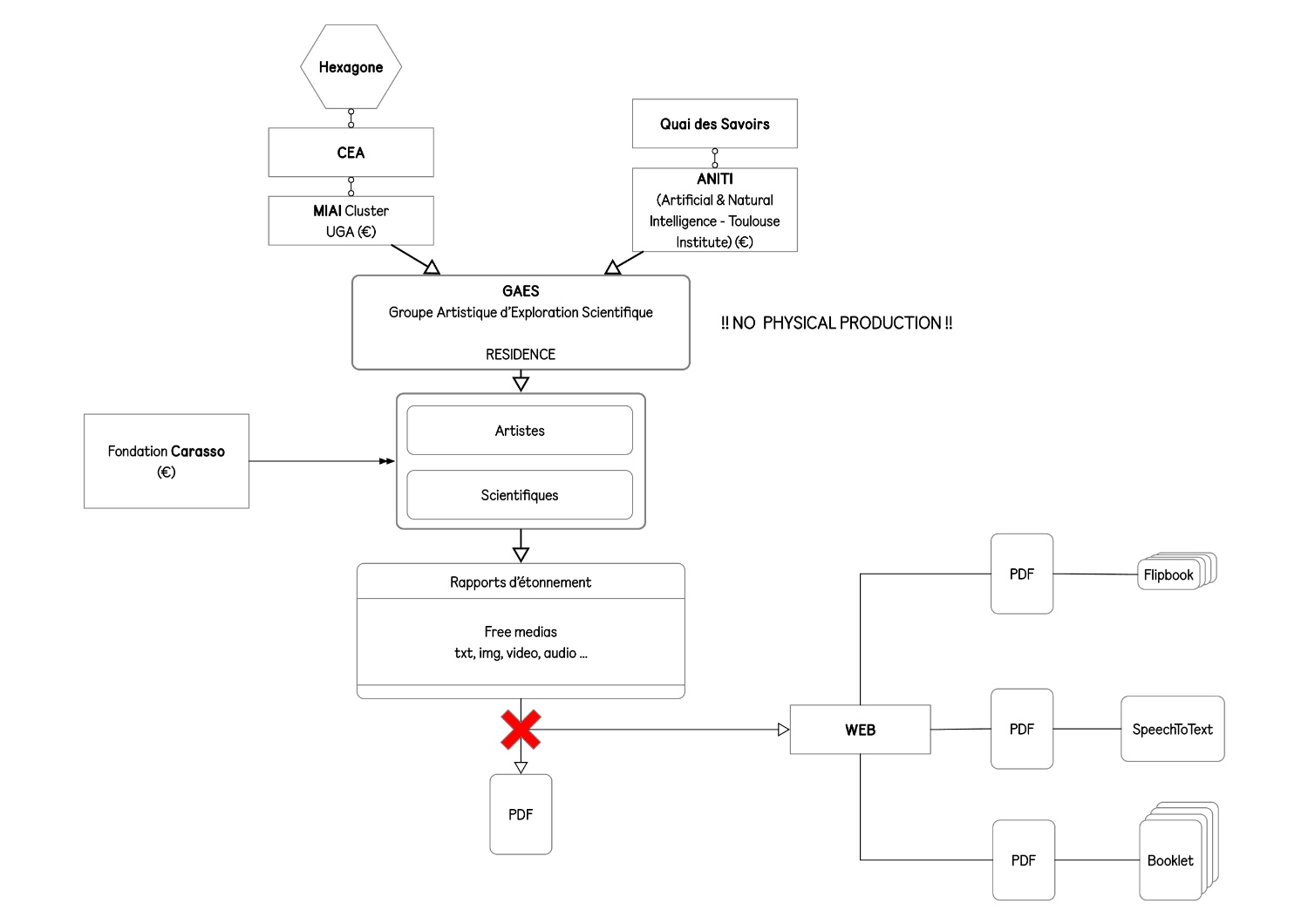
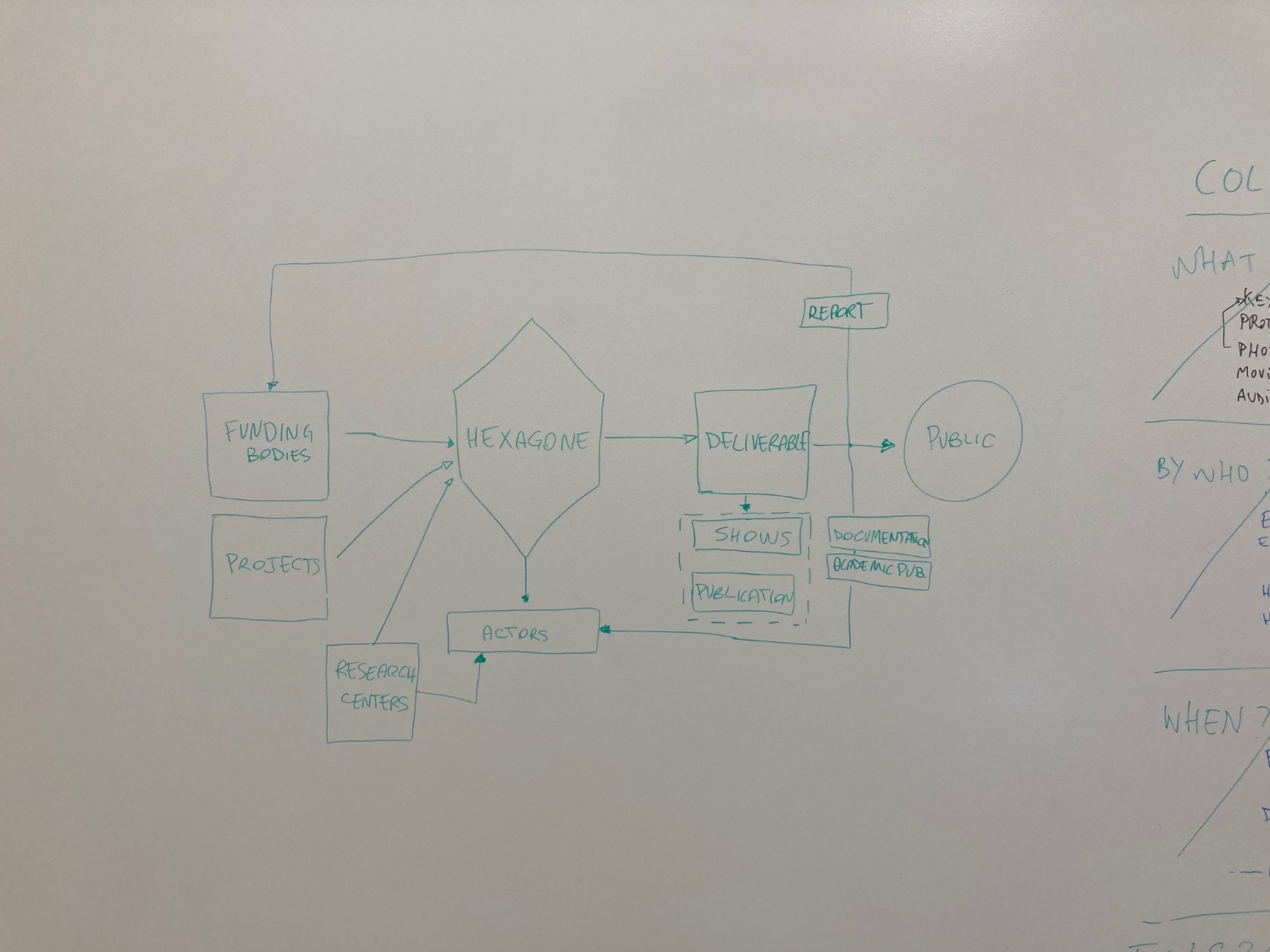
This schematisation enabled us to map the actors involved in these residencies and to better understand the needs of each stakeholder. Afternoon
Two parallel sessions :
Learning session: Clarification of the concept of Single Source Publishing + introduction to the techniques involved (local PHP server, HTML, CSS, CMS, Terminal, etc.). Brief reminder of Paged.js, demonstration of graphic articulations between screen and paper formats. The aim here was to provide a minimum of technical information to those responsible for communication at Hexagone, enabling them to consider a transition from traditional tools with graphical user interfaces to tailor-made tools that integrate the possibility of using description languages such as CSS to define the style and layout of elements in web and printed pages. This led to the introduction of the web-to-print workshop.
Formatting existing data and making it available on a local server, setting up the main technical chain for the rest of the workshop. A second team worked on formatting the 12 Rapports d'étonnement, which served as the raw material for formulating our proposal.
End of session: short demonstration of the proposed chain to share a first idea.
Morning
Sarah Garcin presented the projects she has already implemented that were in line with WS expectations. It consisted in a listing of editorial principles relevant to Hexagone, considering the need for formats aimed at a wide audience and scientific publications (art-science residencies).
Afternoon
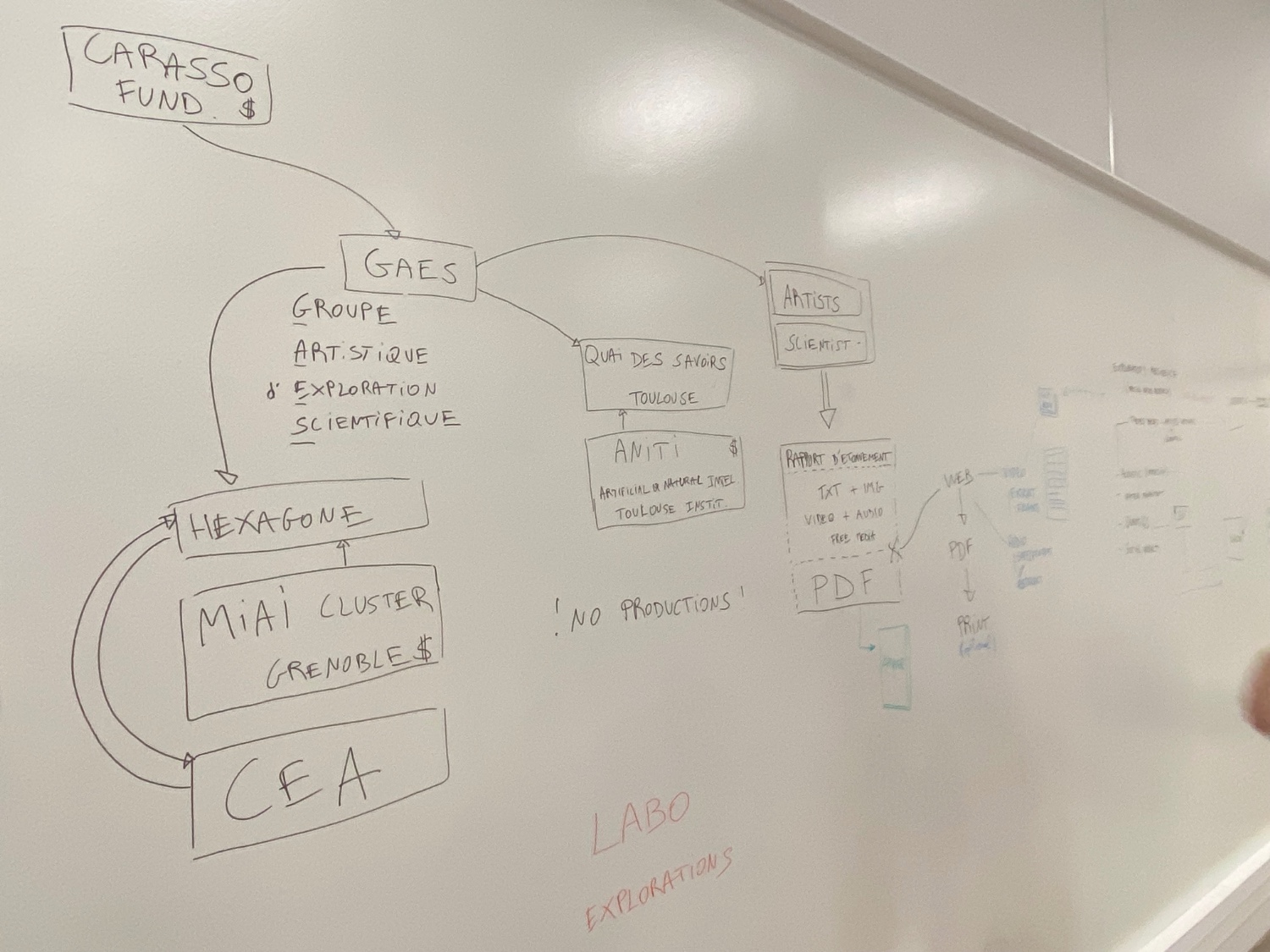
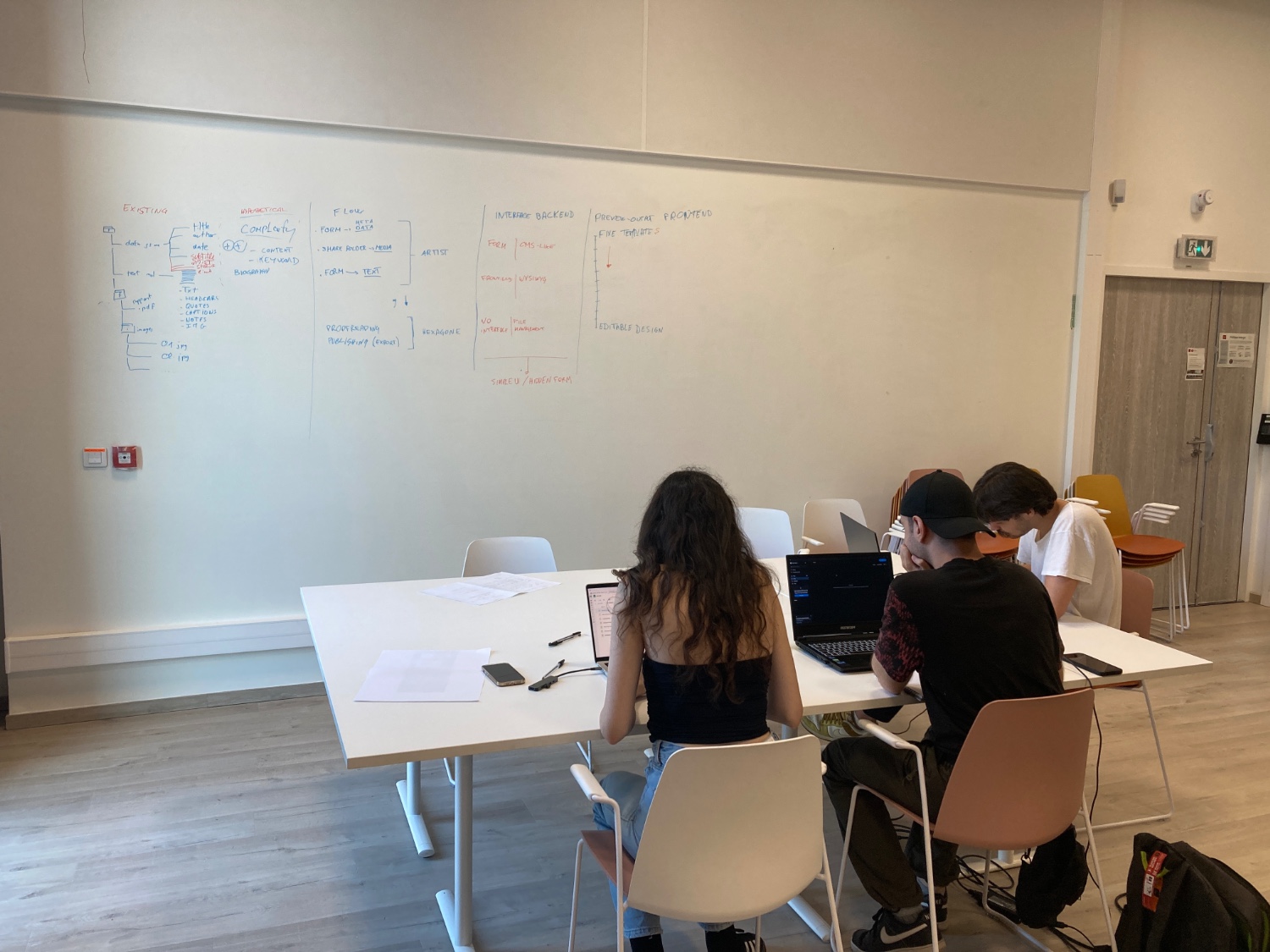
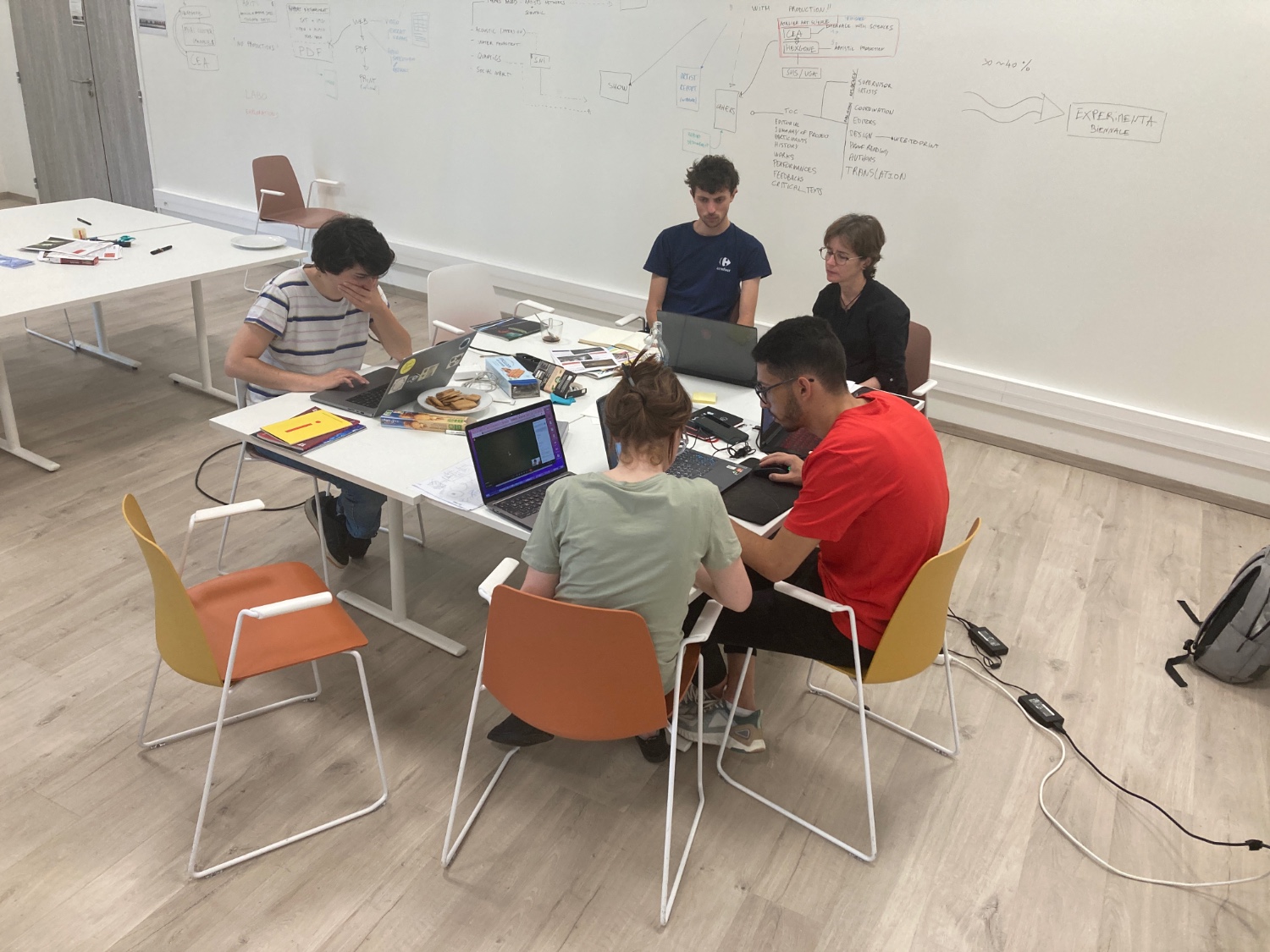
Collective working session for defining major hypotheses for general workflows:
Morning
Team organization:
We had to map out the Hexagone's other residency activities in order to better identify the interactions between the theatre's various departments. Creative residencies are the second major format implemented by the Hexagone team, according to a programme that often depends on the financial resources available at a given time and on the success of project submissions made to a variety of actors. This has a direct impact on the diversity and complexity of project management, depending on the expectations of the calls for projects (production of reports). We had already noted with the Hexagone that there was no policy in place for documenting and disseminating the process and results of these residencies, rendering these activities invisible despite their crucial importance to the theatre's research and creation missions.
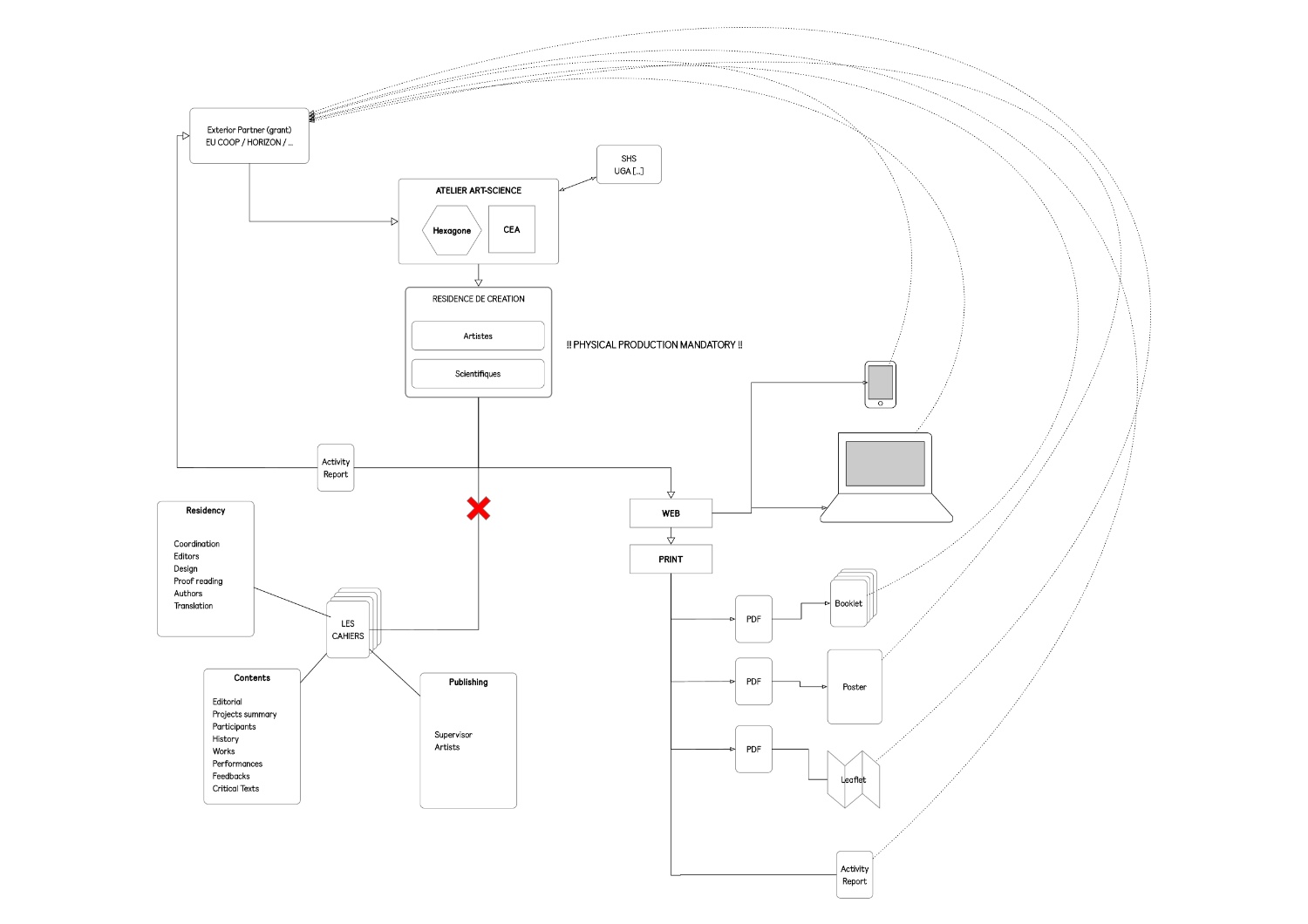
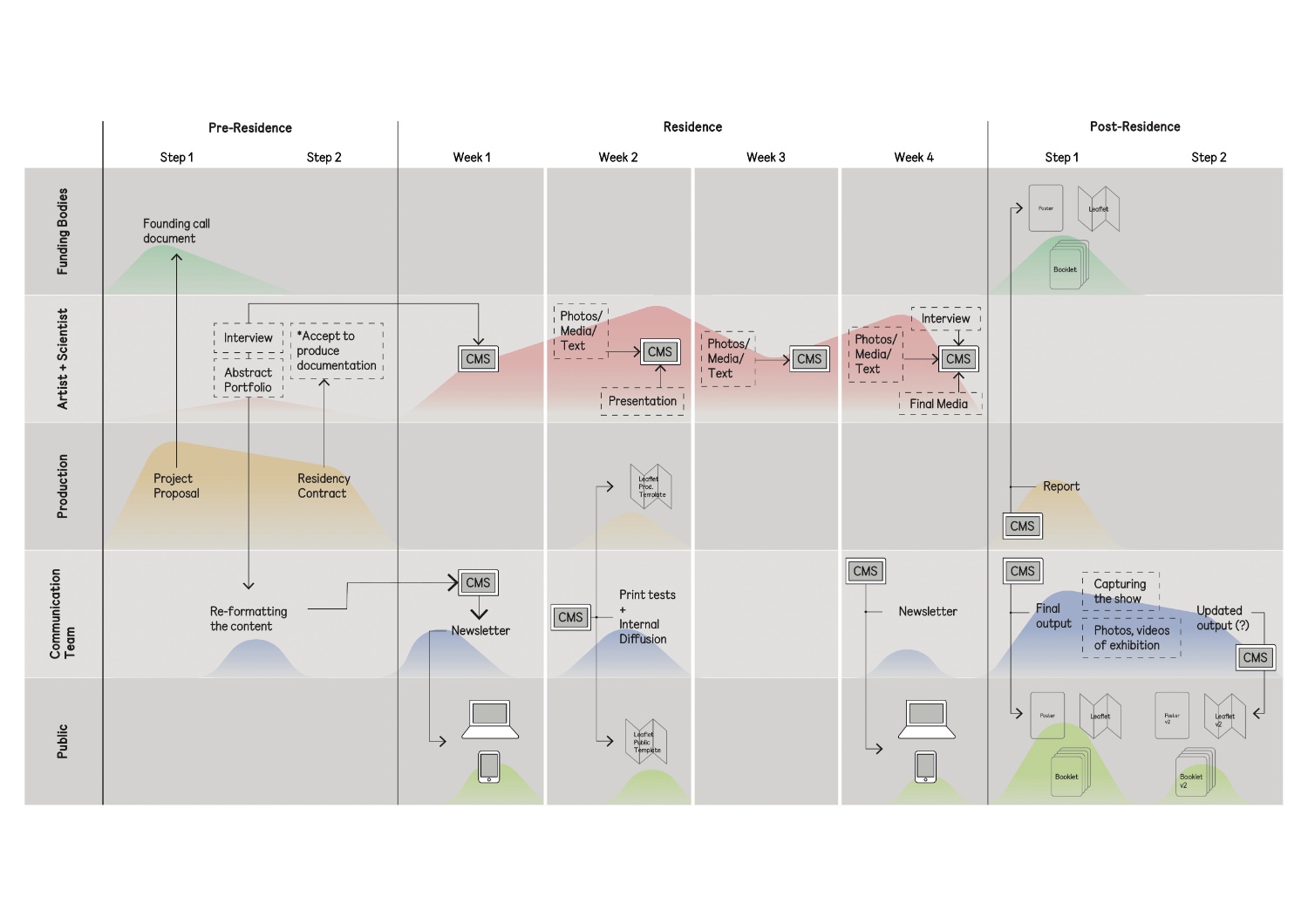
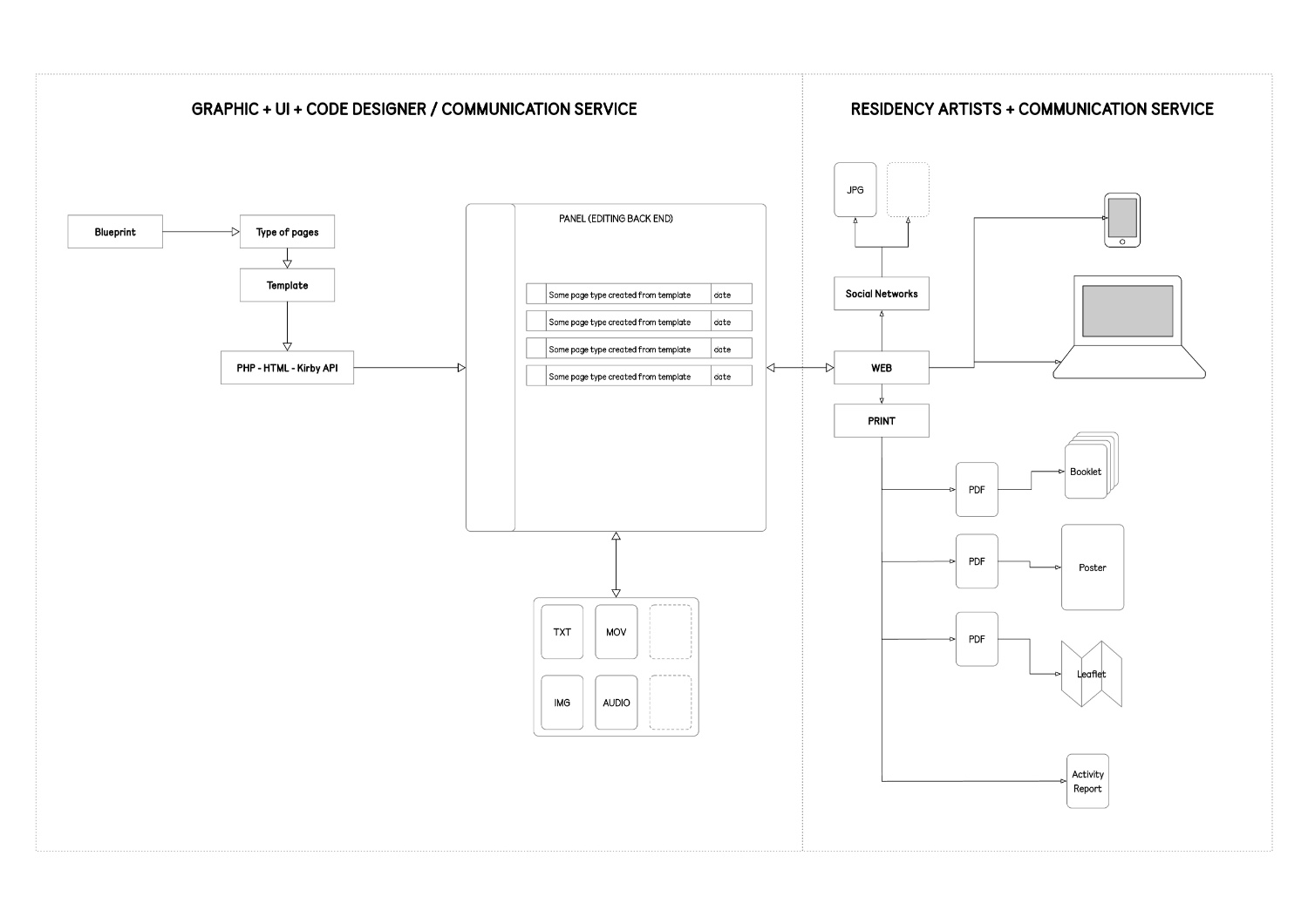
Based on this analysis, which incorporates our web-to-print workflow proposal, we were able to determine a general organisational structure for residencies within the institution. This made it possible to bring all departments into contact with each other and clarify the role and expectations of each:
By gathering testimonials from all those working at the Hexagone, we were able to summarise the organisation of the work:
Afternoon
Graphic format tests: layout initiation (page layout, graphic and typographic choices).
Mock-up continuation. Finalization of a representation of the workflow to be shown and print tests.
Printing and production of objects.
On-site workshop presentation: 3:30pm.
We have decided to carry out a preliminary implementation of our proposed workflow using the Kriby CMS.
Several test websites contribute to the technical and conceptual results.
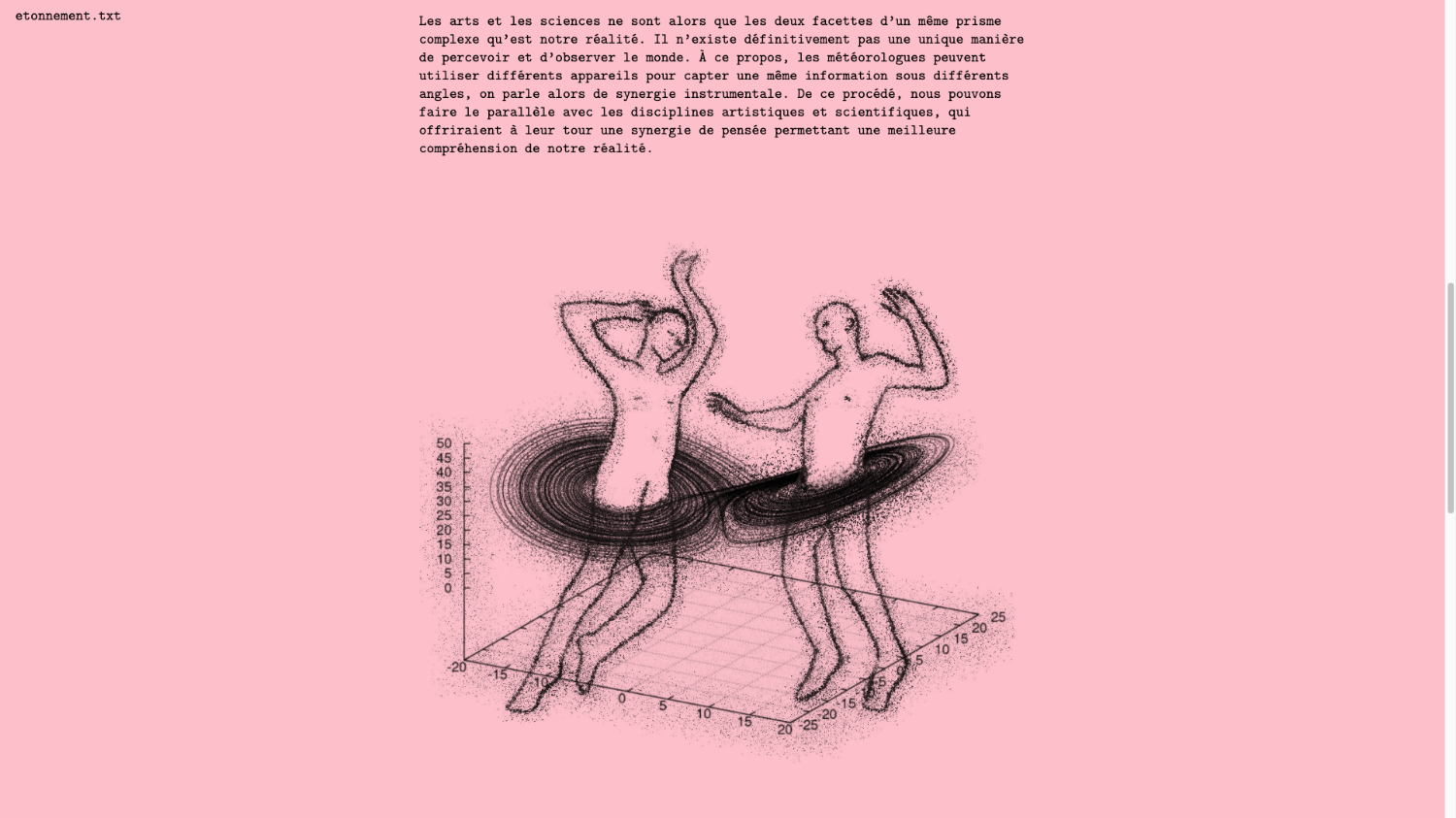
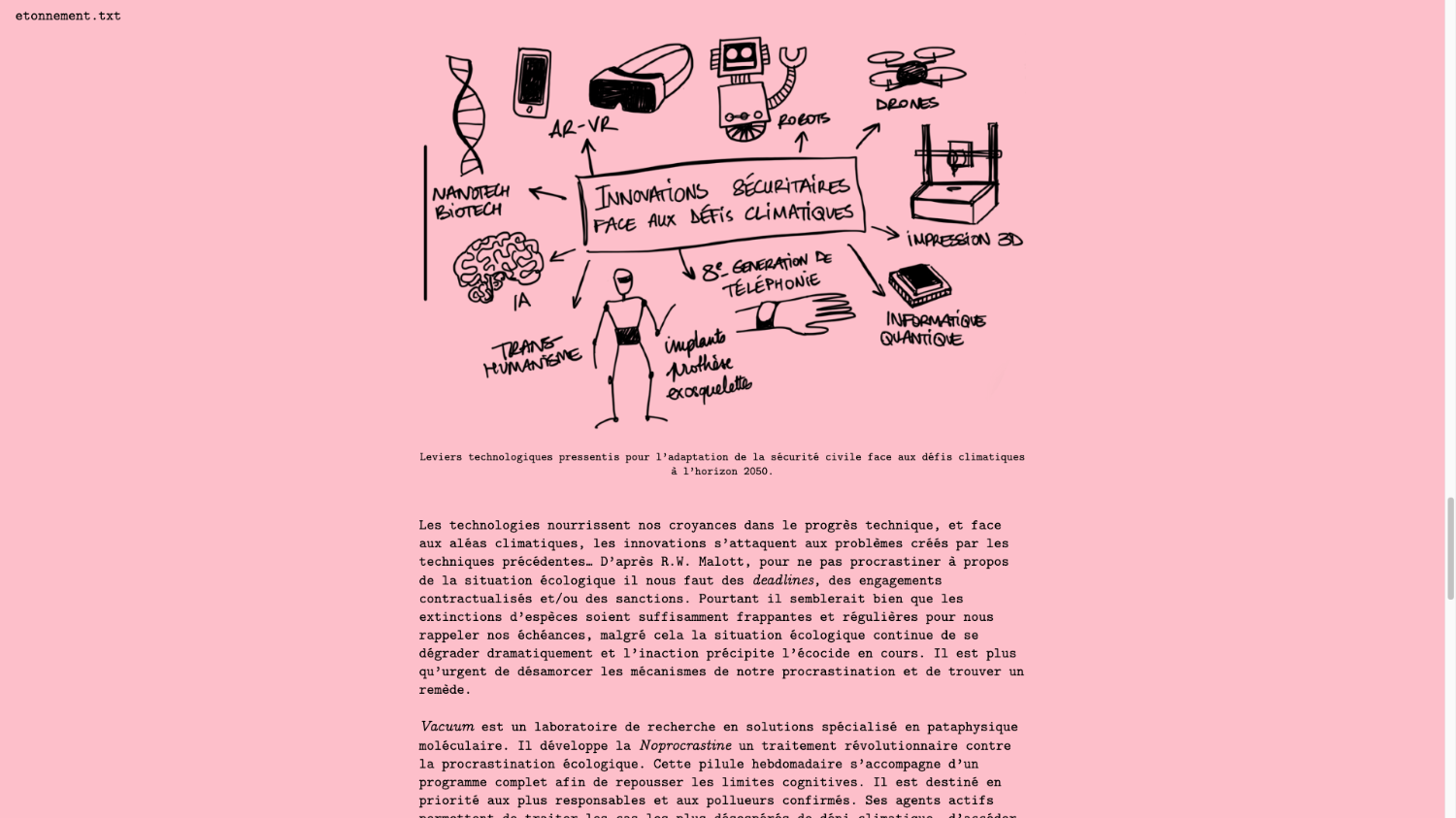
The major contribution is the site that allows users to view and print all the Rapports d'étonnement in a unified and consistent format. In addition to introducing the use of a CMS (Kirby) into the workflow proposed by EPE, this site demonstrates the relevance of all the previous experiments carried out during the other workshops. Furthermore, the use of Page.js for the ‘print’ layout is clearly mastered, and the possibility offered to the reader to select the articles (reports) they wish to print themselves is a specific EPE expertise, made efficient here in a full-scale production project.
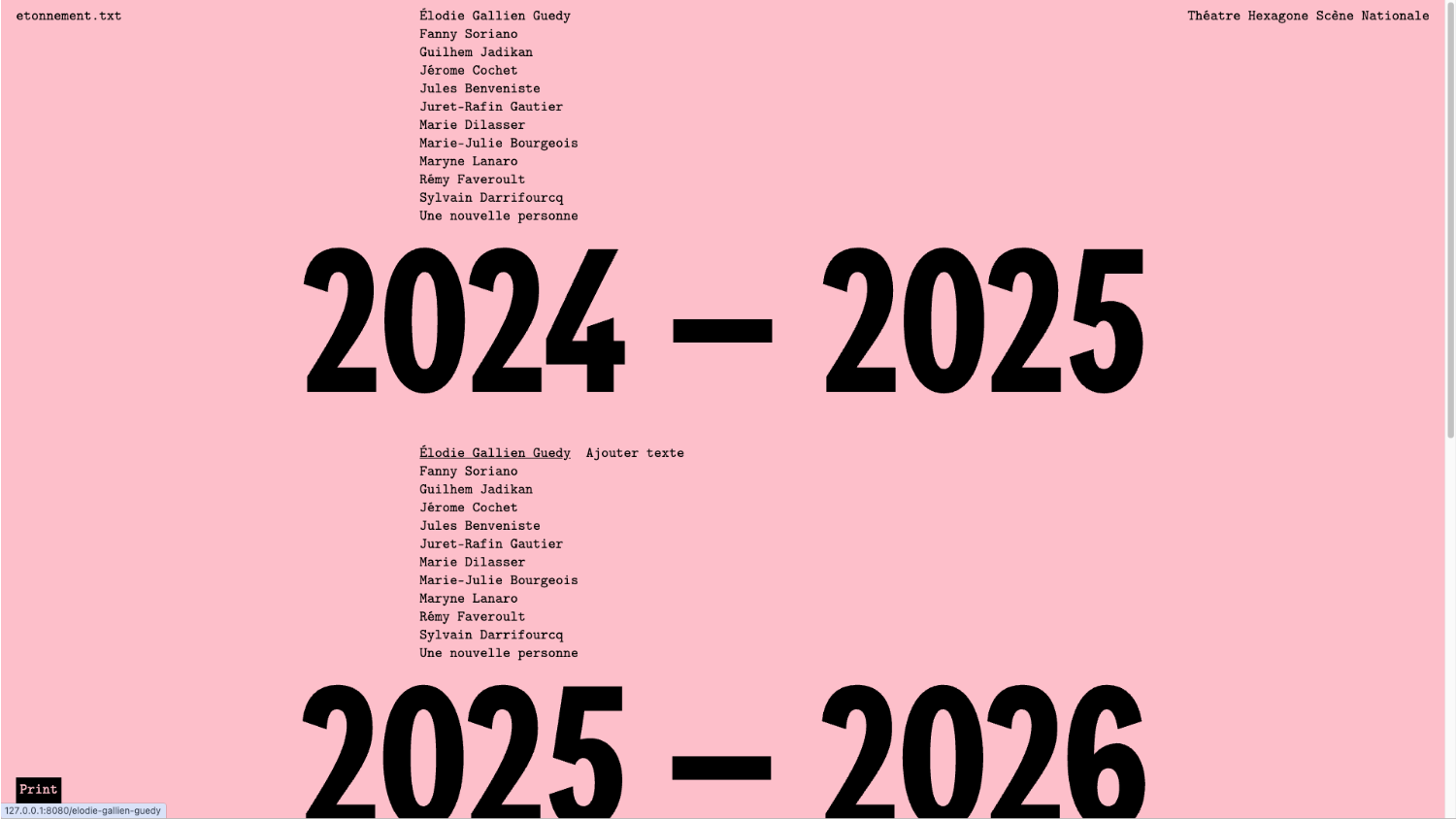
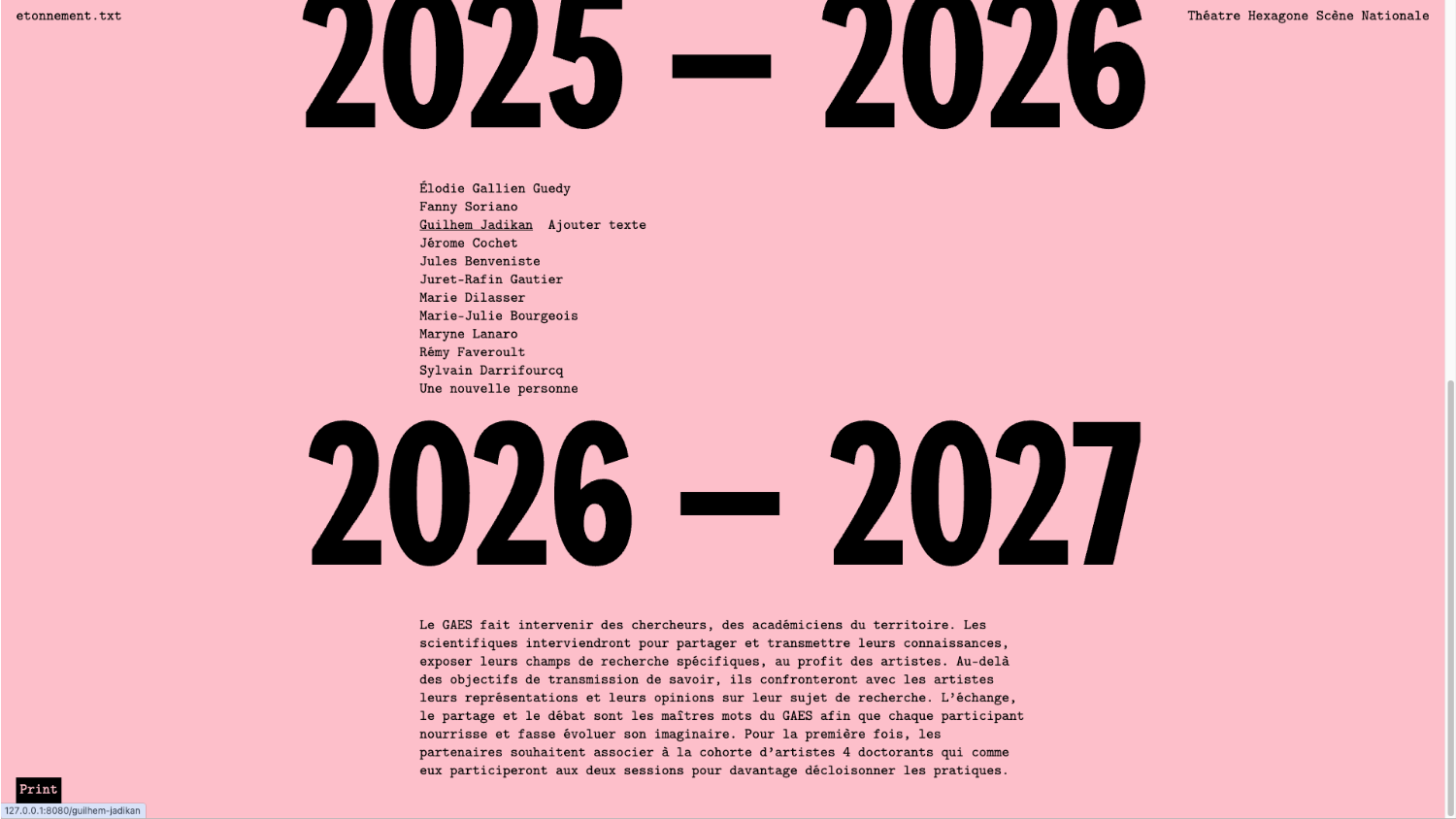
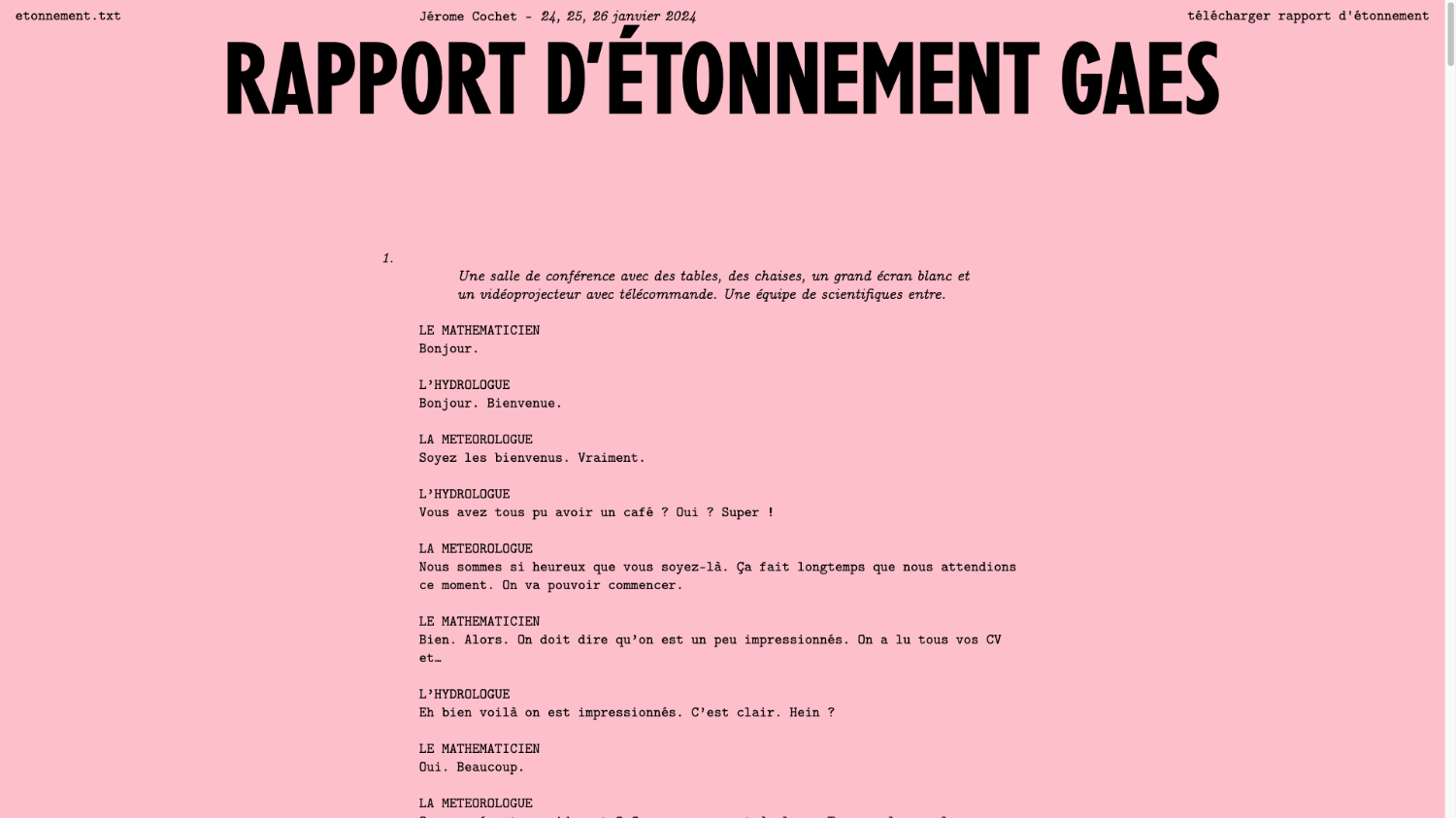
View of the content of one report
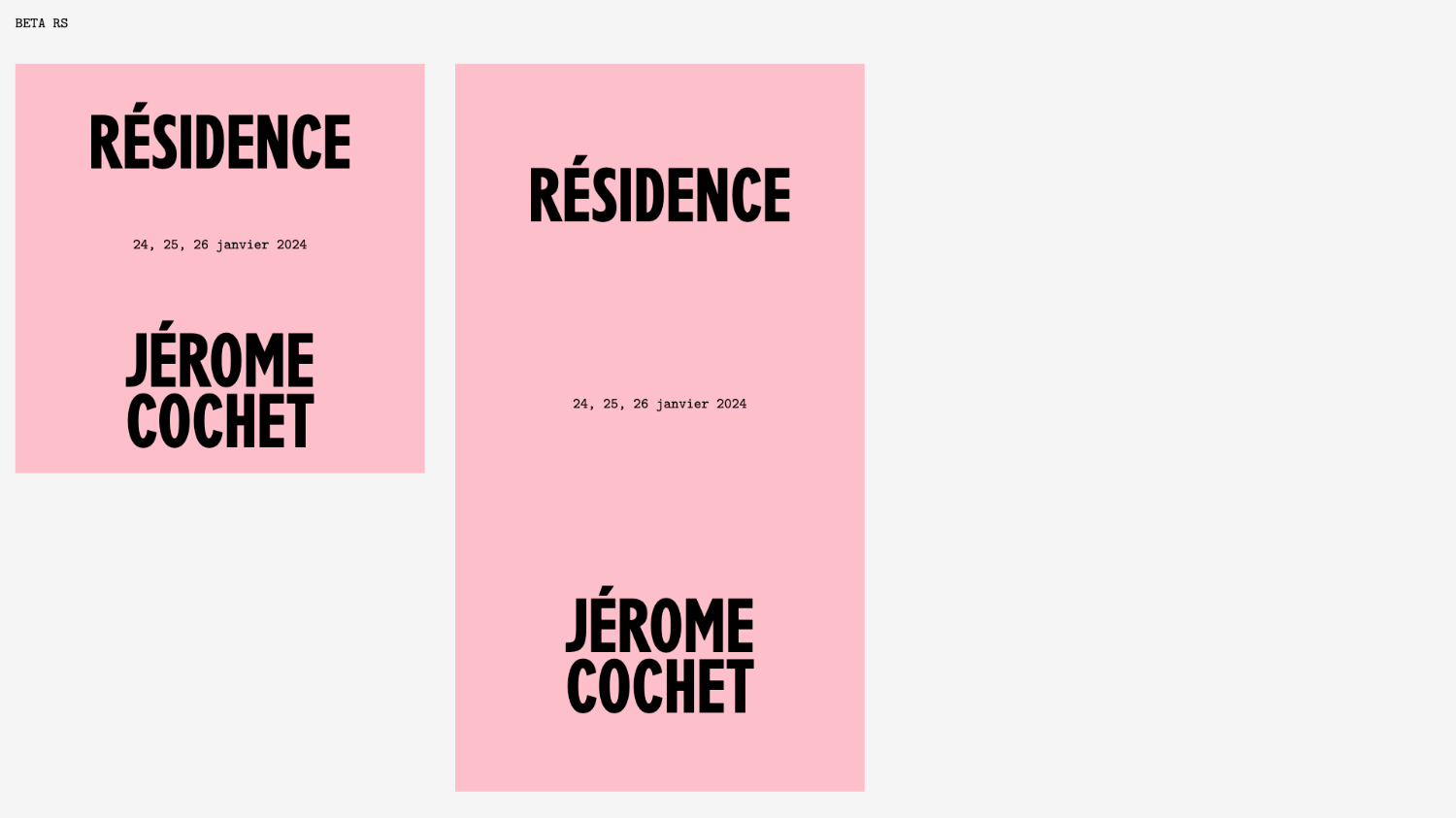
Prototype of an automatic generation of formats for Social Networks
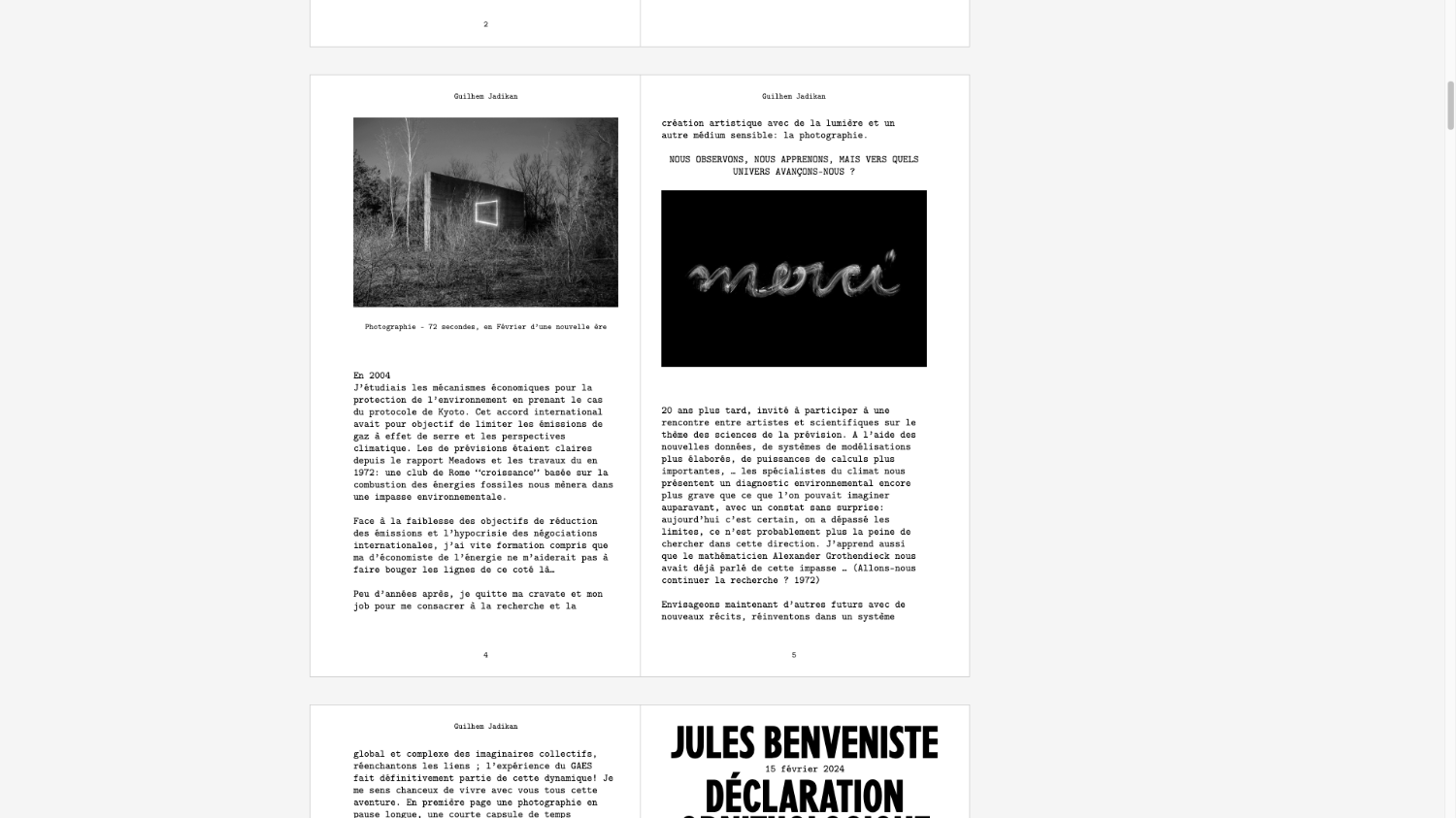
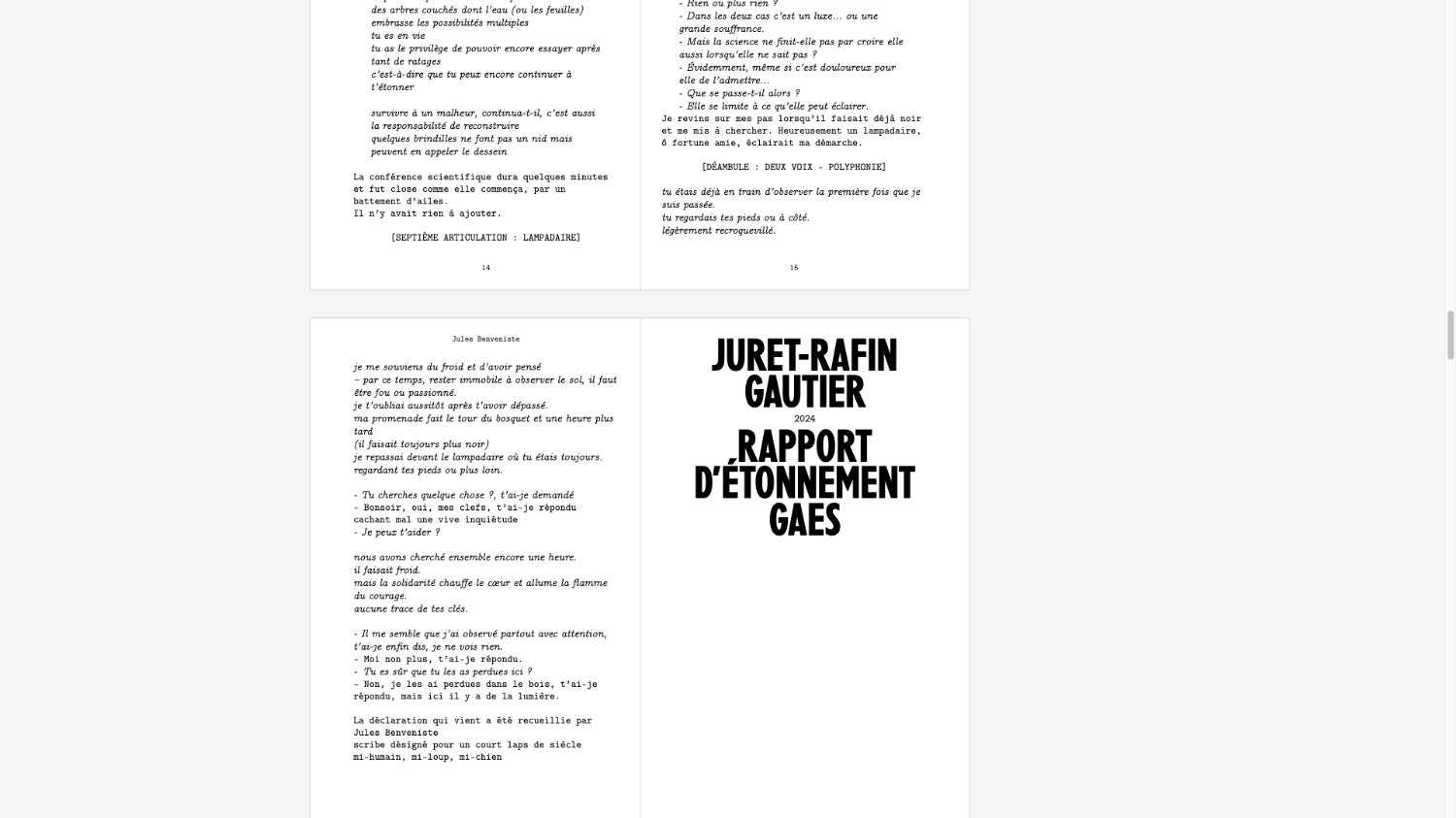
View of the preview before generating a PDF for printing
NB: this site cannot be made publicly accessible online, but its sources are freely available:
https://gitlab.com/esad-gv1/epe/kirbyhexagone
To test the site locally, you need to download it from this GitLab repository, install PHP version 8.3 on your computer, then launch Kirby using a Terminal:
$ git clone https://gitlab.com/esad-gv1/epe/kirbyhexagone.git
$ cd kirbyhexagone
$ php -S 127.0.0.1:8080 kirby/router.php
Alternative graphic designs were developed by the students attending the workshop. It should be noted that the content used here is exactly the same as for the website presented above; only the layout has changed.
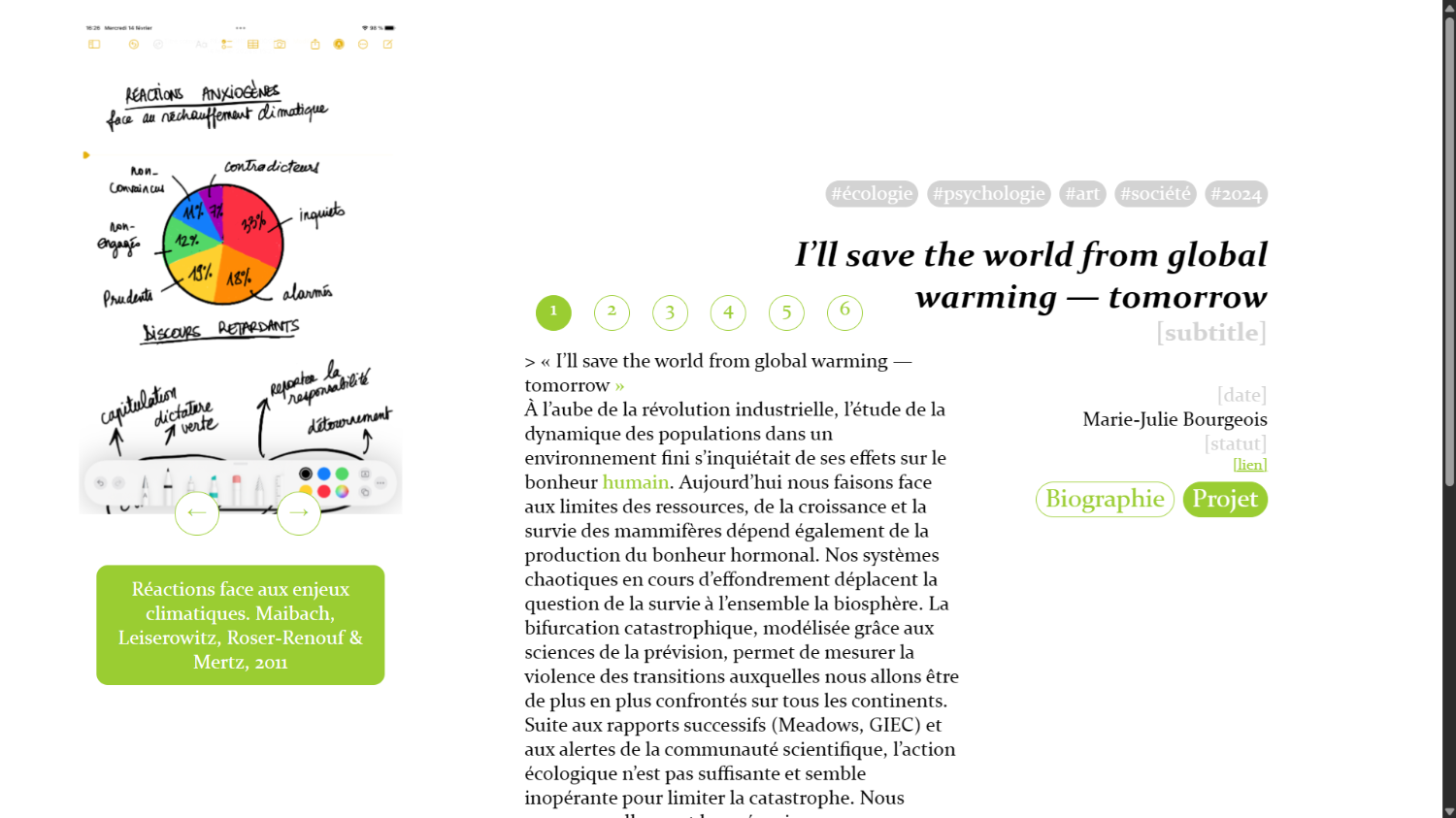
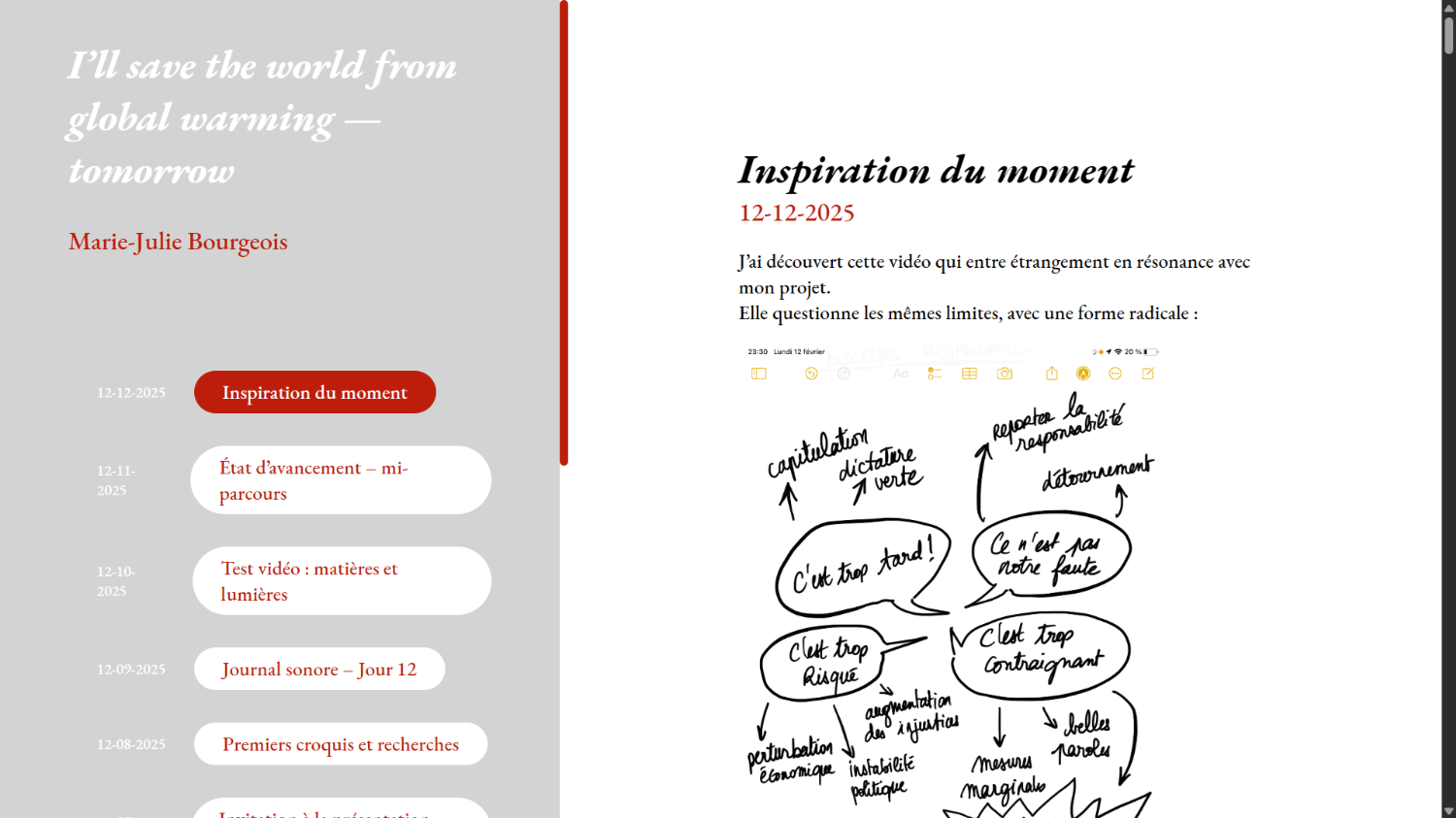
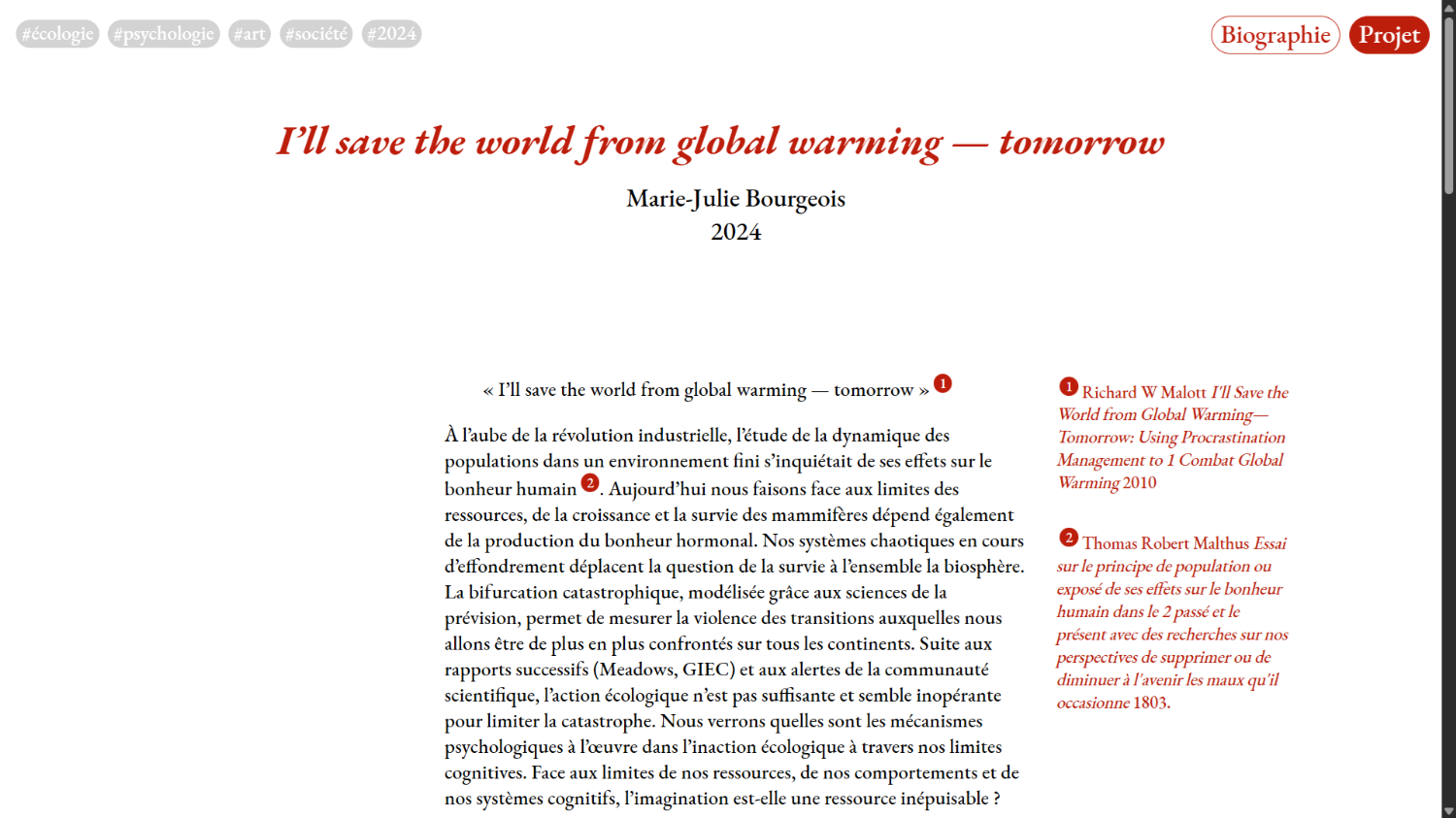
When managing and creating communication documents—whether digital or printed—for a cultural institution such as the Théâtre de l'Hexagone, the concept of web-to-print is key. This approach allows online content management tools to be directly linked to the production of printed materials, based on the principle of single source publishing. The idea is simple: from a single content base, several types of output are generated—web pages, posters, programmes, brochures, press kits, etc. This method ensures consistency of information, avoids unnecessary copying and pasting, limits updating errors and facilitates collaborative work between the various communication stakeholders. In this context, the use of a CMS (Content Management System) is a natural choice. A good CMS offers a clear interface for content management, modularity in data structure, and great flexibility to adapt to the needs of the project. For the EPE Hexagone workshop, we chose the Kirby CMS (getkirby.com), which we felt was the most suitable solution for implementing a customised web-to-print system.
Kirby stands out first and foremost for its ease of installation and flat file system. It is not based on an SQL database, but on an organisation of structured text files and folders (YAML, Markdown or JSON). This architecture makes the CMS readable, sustainable and interoperable, while facilitating versioning with Git, which is an advantage for collaborative and educational projects. It also offers great transparency: content is never locked away in an opaque database, but remains visible and usable. Kirby's administration panel is another strong point. Thanks to its field block system, it allows you to freely compose content: text, images, titles, quotes, lists, etc. Each page becomes a kind of editable mini-layout, where you can add or move blocks as you wish. Above all, these blocks are extensible: it is possible to create new ones tailored to the specific needs of the project — for example, page breaks, blank pages or galleries — to refine the management of multi-page documents. This gives communication managers real autonomy, without compromising graphic and editorial consistency.
Kirby's flexibility doesn't stop there. Each type of content is based on a ‘blueprint/template’ pair, which directly links the data structure to its layout. The blueprint defines the organisation and fields visible in the Panel (e.g. title, summary, main image, dates, distribution, etc.), while the template controls the display on the website — HTML, CSS, JavaScript, Paged.js, etc. This system offers twofold freedom:
Kirby allows you to think of content as reusable data rather than a static web page.
Finally, Kirby remains a comprehensive CMS: user management, roles and permissions, development and production environment, backups, cache, hooks and RESTful API. A professional system, but very lightweight.
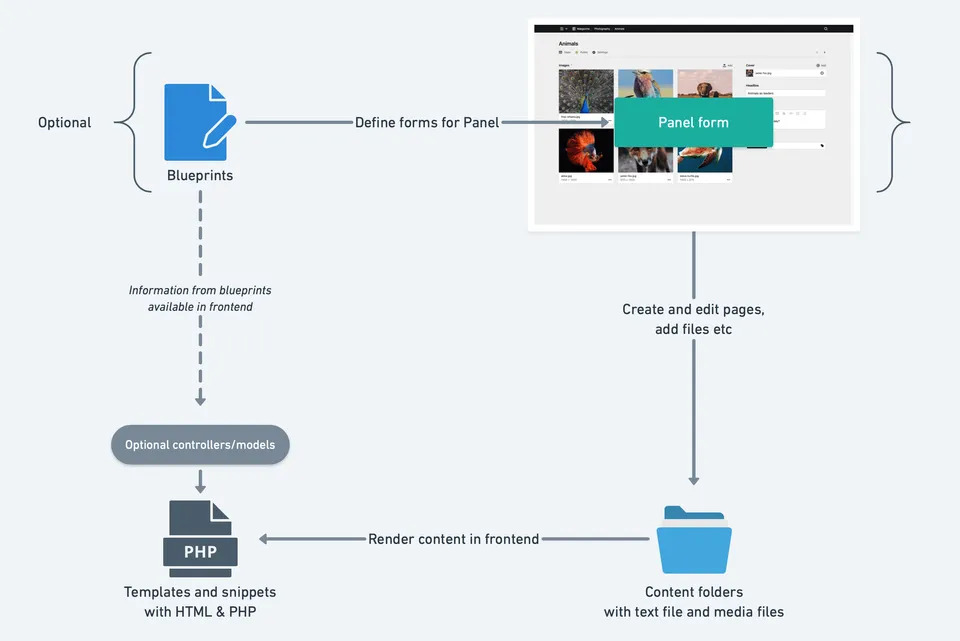
One of Kirby's major advantages is its lack of front-end constraints. The CMS does not dictate which rendering engine, JavaScript libraries or CSS frameworks to use: developers and designers retain complete control over the visual layer. Whether you want to work in vanilla CSS, with Tailwind, SCSS, Bootstrap, or a custom system, anything is possible. Similarly, JavaScript files can be freely integrated (whether for simple dynamic interactions, typography libraries, media management, or more complex tools such as Paged.js for print layout). This freedom is essential in a web-to-print approach: it allows you to experiment and finely control typography, margins, grids and behaviour on screen and in print, without depending on a predefined theme or rendering engine. Kirby thus acts as a ‘pure content base’ that can be styled and formatted according to the graphic requirements of the project.
This front-end flexibility also makes integration with advanced layout tools such as Paged.js, used here to generate printable PDFs, very natural.
Paged.js is a JavaScript library that allows you to paginate and generate PDFs directly from your browser. In our prototype, Kirby serves as both a content base and a rendering engine: using the same data, it can produce a template for the web and another for print (booklets, brochures, flyers, posters), integrating Paged.js for the final layout.This separation of output models is in line with the logic of single source publishing. To go even further, Kirby can also be used as a headless CMS, thanks to its REST (Representational State Transfer) API. This API allows content to be exposed as JSON files and consumed in other environments (JS frameworks, printing tools, automation pipelines, etc.). This paves the way for strong interoperability with other tools in the editorial chain.
One of Kirby's greatest strengths is its community and documentation. It is a vibrant project, actively maintained, with outstanding documentation — clear, comprehensive, and punctuated with concrete examples. There is a very rich gallery of plugins (https://plugins.getkirby.com/) for images, typography, forms, custom fields, authentication, and much more. And if you can't find what you're looking for, creating your own plugin is simple and well documented: Kirby encourages contributions.The official forum is also a particularly welcoming space, where developers, graphic designers and designers exchange tips, prototypes and feedback. This collective dynamic gives Kirby an artisanal spirit that is both solid and sustainable.
Kirby also has the advantage of being extremely easy to test locally. There is no database to configure: just unzip the folder, launch a small PHP server (or even Kirby CLI), and the site is up and running.This makes prototyping very fast — ideal for experimenting with content structures, administration interfaces, or layout templates. And since everything works locally, it is possible to test on a local network, for example to preview renderings on a tablet or smartphone, or to do collaborative demonstrations. It's a small detail, but in a co-creation context, this flexibility changes everything.
As the content is based on readable (flat file) and versionable text files, maintenance and archiving are simplified.
Kirby's file organisation and code are very clear and readable, even for non-developers. This allows for continuity in its development and use, even if developers and users change. It is possible to generate static sites from Kirby sites, which can be very useful in certain cases and for archiving. This allows for the creation of simple, lightweight and sustainable websites.
 ECRANPAPIER
EPE — Écran, Papier, Editer is a European cooperation project funded by Creative Europe and supported by Esad-GV. Its aim is to offer technical chains for editorial creation based on Web technologies (Single Source Publishing, WebToPrint, Open Hardware, etc.).
EPE
ECRAN PAPIER EDITER
ÉSAD Valence
Place des Beaux-Arts
26000 Valence
contact@epe.esad-gv.fr
Developed by Cédric Rossignol-Brunet
Designed by Coline Houot and Romain Laurent
At EPE, accessible from epe.esad-gv.fr, one of our main priorities is the privacy of our visitors. This Privacy Policy document contains types of information that is collected and recorded by EPE and how we use it.
If you have additional questions or require more information about our Privacy Policy, do not hesitate to contact us.
EPE follows a standard procedure of using log files. These files log visitors when they visit websites. All hosting companies do this and a part of hosting services’ analytics. The information collected by log files include internet protocol (IP) addresses, browser type, Internet Service Provider (ISP), date and time stamp, referring/exit pages, and possibly the number of clicks. These are not linked to any information that is personally identifiable. The purpose of the information is for analyzing trends, administering the site, tracking users’ movement on the website, and gathering demographic information. Our Privacy Policy was created with the help of the Privacy Policy Generator.
You may consult this list to find the Privacy Policy for each of the advertising partners of EPE.
Third-party ad servers or ad networks uses technologies like cookies, JavaScript, or Web Beacons that are used in their respective advertisements and links that appear on EPE, which are sent directly to users’ browser. They automatically receive your IP address when this occurs. These technologies are used to measure the effectiveness of their advertising campaigns and/or to personalize the advertising content that you see on websites that you visit. Note that EPE has no access to or control over these cookies that are used by third-party advertisers.
EPE’s Privacy Policy does not apply to other advertisers or websites. Thus, we are advising you to consult the respective Privacy Policies of these third-party ad servers for more detailed information. It may include their practices and instructions about how to opt-out of certain options.
You can choose to disable cookies through your individual browser options. To know more detailed information about cookie management with specific web browsers, it can be found at the browsers’ respective websites. What Are Cookies?
Another part of our priority is adding protection for children while using the internet. We encourage parents and guardians to observe, participate in, and/or monitor and guide their online activity.
EPE does not knowingly collect any Personal Identifiable Information from children under the age of 13. If you think that your child provided this kind of information on our website, we strongly encourage you to contact us immediately and we will do our best efforts to promptly remove such information from our records.
This Privacy Policy applies only to our online activities and is valid for visitors to our website with regards to the information that they shared and/or collect in EPE. This policy is not applicable to any information collected offline or via channels other than this website.
By using our website, you hereby consent to our Privacy Policy and agree to its Terms and Conditions.